



Reward double opt-in with a discount
Compliant two-step opt-ins that deliver an instant discount and lift confirmation rates.
Protect deliverability and maximize launch performance by orchestrating controlled, priority-based email sends.
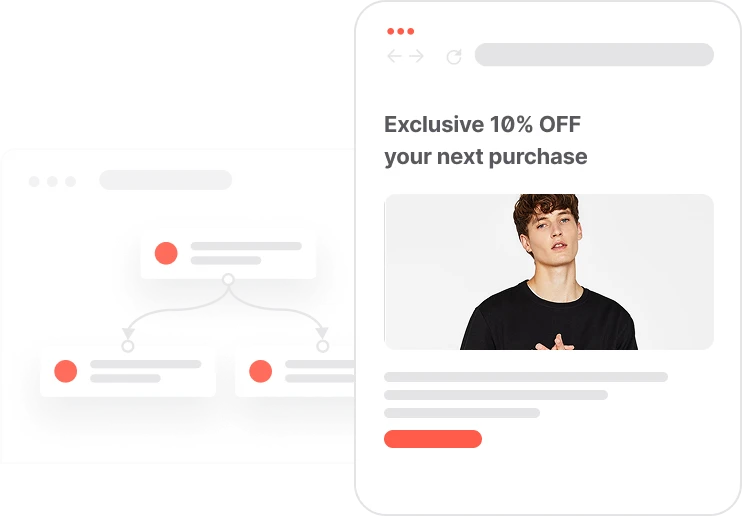
Sending 100,000 emails at once is one of the fastest ways to damage a sender reputation. Mailbox providers see a sudden spike, flag it as unusual, and start routing messages to spam, sometimes permanently. This use case prevents that. Instead of a single simultaneous blast, the launch is broken into four audience segments ordered by engagement level. Most-active customers go first with a short randomized delay. Active leads follow. Less active customers and leads come last, with longer gaps built in. Each group is verified for list hygiene before sending, using Bouncer or equivalent tool recommendations to filter out invalid addresses. The result is a controlled volume ramp that protects inbox placement, maintains domain reputation, and gives the most engaged contacts the best delivery window.
Launch day arrives. The automation starts at the scheduled time. Before anyone gets an email, the system runs through the list: does this contact have an email address? Have they consented? Are they marked as safe to send by Bouncer? Anyone who fails a check is silently excluded. The contacts who pass are then split into four groups. The most active customers, people who have opened emails recently and made a purchase in the last 90 days, are sent first with a delay of anywhere from 0 to 30 minutes. That randomization prevents a simultaneous spike. Active leads follow in the 30–60 minute window. Less engaged customers come next at 90–180 minutes, and the least active leads are last at 180–360 minutes. By the time the final group receives their email, the first group's opens and clicks have already built positive sending signals with the major inbox providers. Reputation protected, inbox placement improved, launch impact maximized.
List verification and suppression filtering: At the scheduled launch time, the system checks three conditions for each contact: they must have a valid email address, have given email consent, and not be marked as suppress in the Bouncer recommends attribute. Contacts failing any of these checks are excluded from the entire flow.
Highest-priority segment: Customers Active. Contacts in the Customers Active segment receive the shortest randomized delay of 0 to 30 minutes. This group includes customers who have recently opened emails or clicked and made a purchase in the last 90 days. Sending to them first builds positive sending signals before the broader list receives their emails.
Active leads distribution: Contacts in the Leads Active segment are queued with a randomized delay of 30 to 60 minutes. This window follows the active customer wave and continues building momentum with the inbox providers before the less engaged groups are reached.
Inactive customers distribution: Contacts in the Customers Not Active segment move into a 90 to 180-minute randomized delay window. The longer gap reduces volume stress on the sending infrastructure and reduces the risk of triggering spam signals during the peak sending period.
Lowest-priority segment: Inactive leads. Contacts in the Leads Not Active segment receive the longest delay, between 180 and 360 minutes. By this point, the active groups have generated strong engagement signals, giving the entire launch the best possible chance of inbox placement across all audience segments.
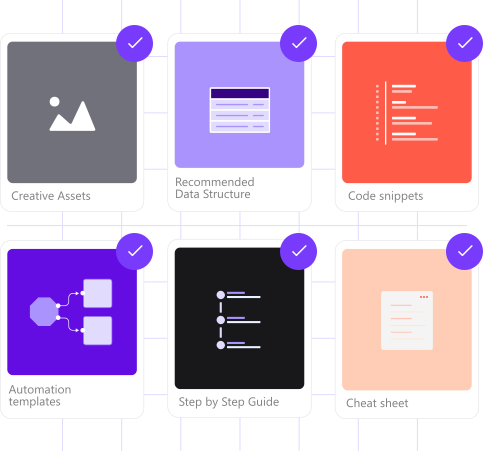
Implementing use case automation involves several key steps and tools. Here's a comprehensive ressources to get you started:
Marketing on a new level with a beautiful visual, drag & drop creator.
Send personalized emails that resonate with your users at the perfect moment.
A contact attribute is a data field stored on the contact's profile, used for segmentation, personalization, reporting, and automation.
Segments are dynamic groups generated based on predefined criteria, which update in real-time as contact behaviors and attributes change.
Use Bouncer (or another tool) to improve segmentation and avoid sending emails to non-deliverable addresses
Trusted by fast-growing teamsStart from a proven use case designed to help you engage faster, with relevance and impact.
More ways to engage your audienceCompliant two-step opt-ins that deliver an instant discount and lift confirmation rates.
In-app messages that surface new features the moment mobile users open the app.
Automated deal and task creation that puts sales on every expired subscription within days.