





Make.com
Build automations that go beyond simple triggers and actions. Connect Positive User to Make.com (formerly Integromat) and design visual, multi-step scenarios with conditional logic, branching, error handling, and data transformations. Sync contacts, events, and deals across thousands of apps, all from one canvas.
Visual Automation Built for Complex Workflows

Design Workflows You Can Actually See
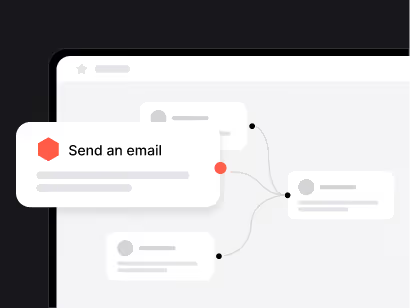
Make.com's scenario builder lets you map out entire workflows as visual flowcharts. Each step, condition, and data transformation is a node you can see, click, and configure. When your Positive User automations involve multiple apps, branching paths, or data manipulation, having a visual layout makes the logic obvious instead of buried in spreadsheet-like settings.
Go Beyond Simple If-This-Then-That
Zapier-style automations handle one trigger and one action well. Make.com handles everything else. Need to iterate over a list of contacts, filter them by attribute, route them to different apps based on conditions, aggregate results, and handle errors mid-flow? Make.com does it natively, on the same canvas, without splitting your automation into ten different workflows.

Connect Positive User to Thousands of Apps
Make.com supports thousands of integrations. Combine Positive User with your CRM, helpdesk, spreadsheets, project management tools, payment processors, and more in a single scenario. Data flows between all of them in real time, orchestrated by logic you control.
Three simple steps to get started
Create Your Make.com Account
Sign up at Make.com. Once registered, go to the Scenarios section and create a new scenario.
Add the Positive User Module
In the scenario editor, search for "User.com" (the connector name on Make.com) and add it as a module. Authorize the connection by entering your Positive User API key and app domain, found in Settings > Setup & Integrations.
Build, Test, and Activate
Add other app modules to your scenario, configure triggers and actions, set up filters or routers if needed, then run a test. Once the data flows correctly, activate the scenario and let it run on schedule or in real time.

Popular implementation guides
- Make.com Integration: Step-by-step walkthrough of connecting Positive User to Make.com, creating your first scenario, and configuring the User.com module. Read Guide →
- Positive User on Make.com: Browse the official User.com integration page on Make.com for available triggers, actions, and pre-built templates. View on Make.com →
- What Are Events and How to Create Them: Learn how to define events and their attributes in Positive User before using them as triggers or actions in Make.com scenarios. View Tutorial →
- How to Integrate With Zapier: Already using Zapier? Compare the two approaches and decide which automation platform fits your workflow complexity. Read Guide →
- REST API Documentation: For scenarios that need custom HTTP requests or webhooks, the Positive User API gives you direct access to every endpoint. View Docs →
- Google Calendar Integration: Combine Make.com scenarios with the Positive User Google Calendar integration for automated scheduling workflows. View Tutorial →
Frequently Asked Questions
Do I need coding skills to use Make.com with Positive User?
No. Make.com is a visual, no-code platform. You build scenarios by dragging modules onto a canvas, connecting them, and configuring fields through forms. Advanced features like iterators, aggregators, and conditional routing are all configured visually.
What's the difference between Make.com and Zapier for Positive User?
Both platforms connect Positive User to thousands of apps. Zapier is simpler and faster to set up for basic one-trigger, one-action workflows. Make.com is better suited for multi-step scenarios with conditional logic, iterators, error handling, and complex data transformations. Many teams use both: Zapier for quick automations, Make.com for the sophisticated ones.
What Positive User triggers and actions are available on Make.com?
The User.com module on Make.com supports triggers for new contacts, companies, deals, events, and activities. Actions include creating and updating contacts, companies, deals, sending events, and managing tags. The full list is on the official integration page on Make.com.
Can I build real-time scenarios or only scheduled ones?
Make.com supports both. You can configure scenarios to run instantly (triggered by a webhook or event) or on a schedule (every few minutes, hourly, daily). Real-time execution is available on most paid plans.
How does Make.com handle errors in a scenario?
Make.com has built-in error handling modules. You can define what happens when a step fails: retry, ignore, route to an alternative path, or stop the scenario. This is a significant advantage over simpler tools, where a single failed step can break the whole automation.
Can I use Make.com to sync data between Positive User and my CRM?
Yes. This is one of the most common use cases. You can build a scenario that watches for new or updated contacts in Positive User and pushes them to your CRM (Salesforce, HubSpot, Pipedrive, and many others), or the other way around.
Is there a limit on how many modules I can add to a single scenario?
Make.com allows complex scenarios with many modules. The practical limit depends on your Make.com plan, which determines the number of operations per month. Each module execution counts as an operation.
Can I use Make.com to process bulk data from Positive User?
Yes. Make.com's iterator and aggregator modules let you loop through lists of records (for example, all contacts with a specific tag) and process them one by one or in batches. This is ideal for migrations, bulk updates, or scheduled reporting.
What does the connector name look like on Make.com?
The Positive User connector appears as "User.com" on the Make.com platform. Search for "User.com" when adding a module to your scenario.
Is the data GDPR-compliant?
Both Make.com and Positive User offer GDPR compliance tools. Make.com provides a data processing addendum (DPA) and hosts data in the EU. Positive User includes consent management and data deletion features. Review both providers' policies before processing personal data through your scenarios.