




Summary
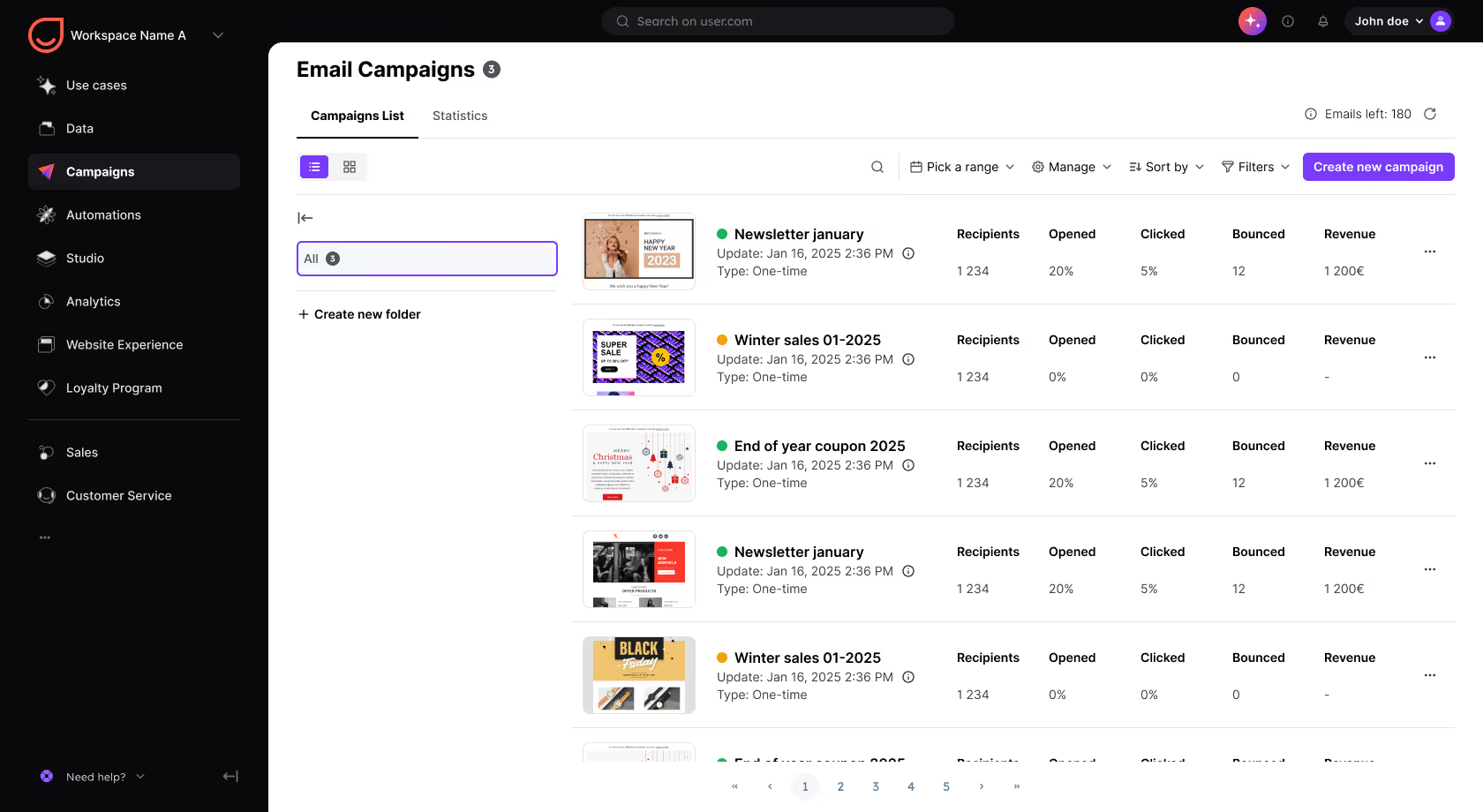
Email click-through rate (CTR) is the percentage of recipients who clicked at least one link in your email. It is a more reliable indicator of genuine engagement than open rate, since it requires active intent rather than a passive behavior. This article covers the CTR formula, the difference between CTR and CTOR (click-to-open rate), realistic benchmarks by campaign type, the five main factors that affect CTR including content relevance, CTA visibility and copy, personalization, send timing, and mobile optimisation, and five proven improvement tactics. Related email KPIs are covered at the end.
Email Click-Through Rate: What It Means and How to Improve It
Open rate gets a lot of attention as a headline metric, but it is a weaker measure of email performance than most people assume. Apple's Mail Privacy Protection, introduced in 2021, pre-loads email tracking pixels for Apple Mail users, which inflates open rates for a significant share of most audiences. Click-through rate is harder to game. Someone either clicked a link or they did not. That makes it a much more reliable signal of whether your email actually generated any engagement.
What CTR measures
Click-through rate is the percentage of recipients who clicked at least one link in your email, calculated against total emails delivered. The formula: unique clicks divided by emails delivered, multiplied by 100.
There is a related metric worth distinguishing. CTOR (click-to-open rate) measures clicks against opens rather than total deliveries. Where CTR gives you the overall picture, CTOR helps you isolate content performance. If your CTR is low but your CTOR is healthy, the issue is probably your subject line or deliverability, not the email content itself. If both are low, the content is the problem.
What counts as a good CTR?
It varies considerably by industry, audience, and email type, which is why generic industry benchmarks are best used as rough orientation rather than firm targets. For regular marketing emails across most sectors, a CTR of 2 to 4% is common. Segmented, personalised campaigns often see 5 to 10%. Transactional emails, such as order confirmations and shipping notifications, typically outperform everything else because recipients are actively looking for the information they contain.
The most useful benchmark is your own historical data. If your CTR has been trending upward over the past six months, you are moving in the right direction. If it is flat or declining, something in your content, targeting, or frequency needs to change.
What drives CTR up or down
Content relevance is the biggest lever by far. An email sent to the right person at the right moment about something they actually care about will produce a higher CTR than a beautifully designed, well-written email sent to the wrong segment. Segmentation and personalization are not nice-to-haves. They are the primary drivers of click performance.
Your CTA needs to be impossible to miss and phrased in a way that tells the reader exactly what they will get when they click. "Download the guide" outperforms "Submit". "Start my free trial" outperforms "Sign up". The button should stand out visually from the surrounding design, be positioned above the fold, and be large enough to tap comfortably on a smartphone screen.
Personalization beyond the first name also moves CTR meaningfully. Dynamic content blocks that show different messages to different subscribers based on their profile, purchase history, or behavior consistently outperform static emails.
Send timing plays a role, because an email that lands in the inbox at the right moment for the recipient is simply more likely to get clicked. For most B2B audiences, Tuesday and Thursday mornings tend to perform well, though your own data should take precedence over any general guidance. What is the best time to send newsletters? explores this in more depth.
Mobile optimisation is non-negotiable at this point. Most emails are opened on phones. If your CTA button is awkward to tap, your email requires pinching to read, or your layout breaks on a small screen, you are actively suppressing your own click rate.
Improving your CTR in practice
Use a single primary CTA per email. Multiple competing calls to action dilute attention and often result in lower click rates overall. Decide what the most important action is and design the email around it. Secondary links are fine, but they should not compete visually with your primary CTA.
Test your segments before scaling. Before sending to your full list, run the campaign against a smaller, targeted segment. A strong CTR in a narrow test gives you confidence before broader deployment, and often reveals opportunities to segment further.
Use A/B testing consistently. Subject line, CTA copy, button color, email length, content structure: test one variable at a time, wait for statistical significance, and implement the winner. Consistent testing over six months compounds into real improvements.
CTR makes most sense when read alongside the rest of your campaign data: bounce rate, open rate, conversion rate, and unsubscribe rate. A high CTR that does not translate into conversions usually points to a landing page problem. A low CTR despite a strong open rate suggests the content or CTA is not resonating, not the subject line.