


Summary
Omnichannel marketing means your channels share one record of the customer, so each one knows what the others already did. A click in a text message is visible when you plan the next email, and an unsubscribe in one channel applies to all of them. That shared record is what separates it from running several channels at once, which most companies already do. Two channels writing to a shared profile qualify; six channels in six separate tools do not.
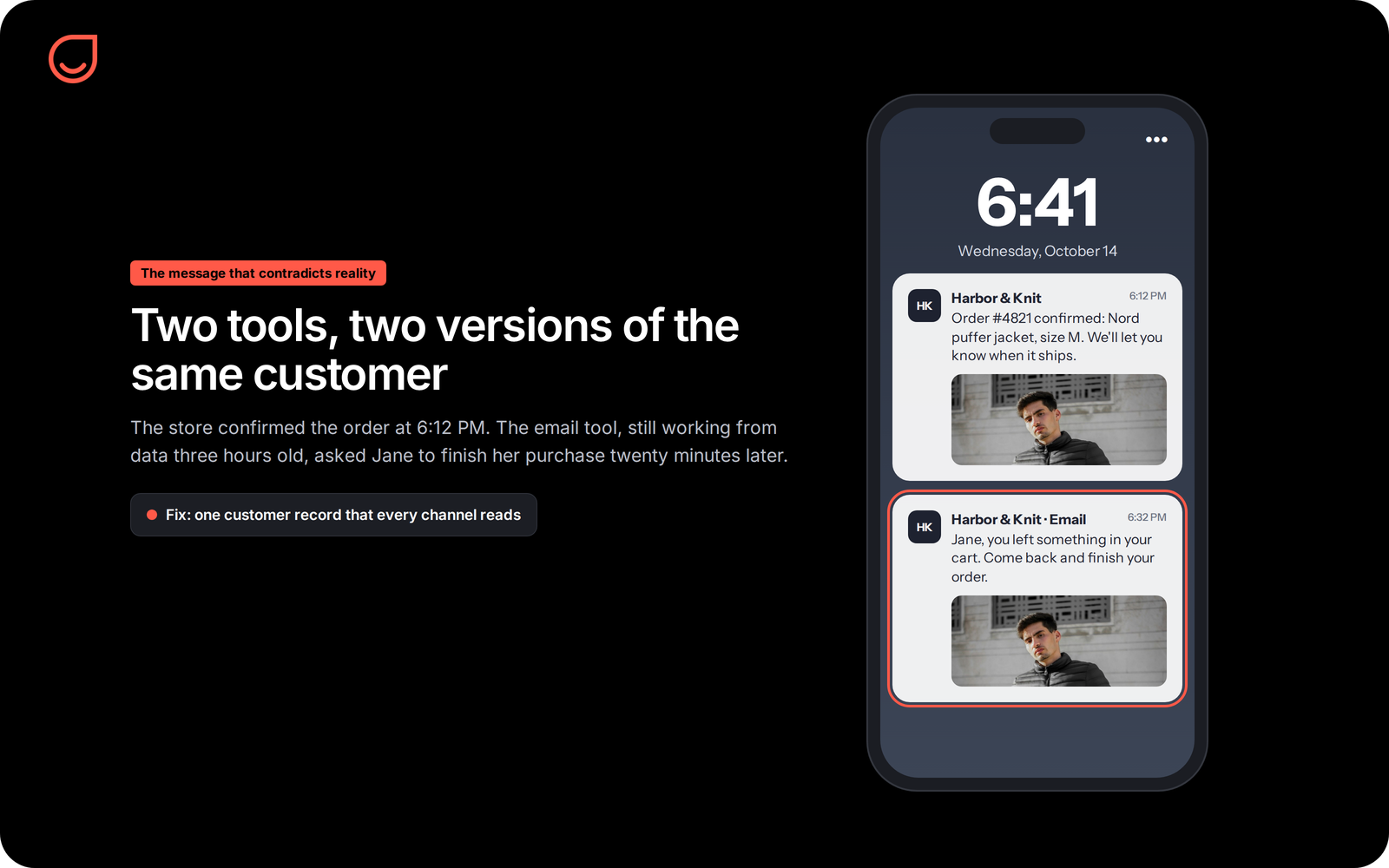
Someone buys a jacket on their phone during the commute home. Twenty minutes later, an email lands asking them to come back and finish their order. It's the kind of gap the Positive User omnichannel platform is built to close.
Nobody made a mistake. The email platform had no way of knowing what the store had already done. It ran the reminder it was told to run, on the data it could see, and the data it could see was three hours old.
That gap is what omnichannel marketing exists to close, by making the channels you already pay for tell each other what happened.
What omnichannel marketing actually means
Omnichannel marketing means your channels share one record of the customer, so each one knows what the others already did. A click in a text message is visible when you plan the next email. A chat conversation is visible before you send an offer. An unsubscribe recorded in one place applies everywhere.
The phrase you will meet everywhere for this is a "seamless customer experience", sometimes a "seamless user experience". It does a lot of work for something nobody can measure. A more testable definition is that the next channel knows what the last one did. If it doesn't, the word "seamless" is decoration.
Most companies are already present in several channels. That is multichannel marketing, and it mostly means having a lot of logins. Email marketing in one tool, SMS in another, chat in a third, each with its own list that drifts a little further from the others every week. The channels exist. They just don't talk.
The number of channels you run doesn't decide it. Two channels writing to a shared profile qualify. Six channels in six tools do not, however good each one is on its own.
There is a second half to this that gets less attention. A shared record makes your messages coordinated, and consistent messaging is what makes them coherent. The two reinforce each other. A consistent brand message across different channels is what makes the shared record feel like one company rather than four departments taking turns, and together they produce consistent customer experiences, which is what customers actually remember.
Why this stopped being a nice-to-have
Marketing budgets have stopped growing. Gartner's 2025 CMO Spend Survey put them flat at around 7.7% of company revenue, and 59% of CMOs said that is not enough to execute the marketing strategies they have been given.
Technology spending, meanwhile, did not get the memo. Forrester's global martech forecast had it at 148 billion dollars in 2024, heading toward 215 billion by 2027.
Read those two together and you get the shape of the problem. Companies keep buying marketing channels and keep running out of budget to use them properly. Owning more tools doesn't put anyone ahead. An omnichannel strategy in which the tools you already own write to the same place does.
Customer expectations moved first, which is the usual order. People don't think in terms of digital channels and offline channels. They think about one company they are trying to buy from.
Digital and physical channels are the same problem
Omnichannel is usually explained through retail, and the retail version is the clearest. Somebody browses on a mobile app, checks stock at a brick and mortar store, buys in store, then returns by post. Four customer touchpoints, one person, one purchase. In store experiences and digital marketing are two halves of one program here.
The same structure applies with no physical stores at all. A B2B buyer reads a comparison from search engines, joins a webinar, talks to a chatbot, then emails a rep. Also four touchpoints, also one person.
What makes physical channels feel harder is that the data lives further away, in a point of sale system or an inventory management tool rather than in a marketing platform. The principle stays the same. If in store visits and online behavior don't land on the same record, you are running two businesses that happen to share a logo.
One customer record, or none of this works
Omnichannel starts with data structure, well before any channel roadmap or vendor demo.
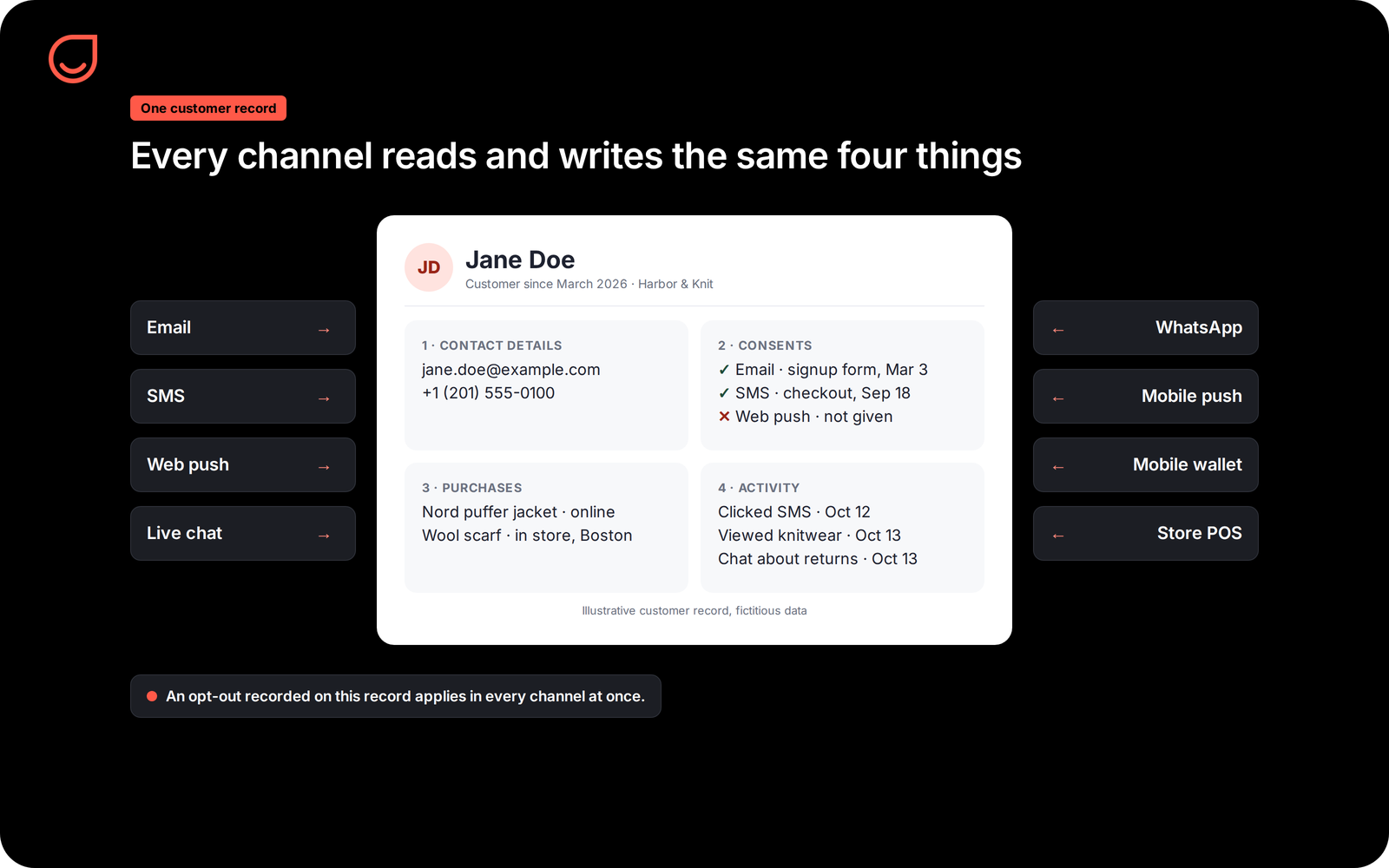
A usable customer record holds four things:
- Contact details for every channel you can reach the person on
- Every consent, with the date it was given and where it came from
- What they bought, online and offline
- What they did, in whichever channel they did it
That fourth line is where a unified customer view stops being a slide and starts being useful. Customer behavior from one channel has to be readable by the next one, or personalized experiences are just a word in the brief. It is also what lets you see the entire customer journey rather than the last step of it, which is the only way to learn anything about customer preferences that you did not already assume.
Consent is where most setups quietly break. If SMS consent lives in the SMS tool and email consent lives in the email platform, within a few months neither one holds the full picture. That leaves you unable to do two fairly important things: prove consent when someone asks for it, and stop sending to a person who already told you to stop.
Three failures, and none of them are anyone's fault
These repeat across industries, across company sizes, and across teams who are all doing their jobs properly. They come from customer data sitting in separate places, which is a structural problem wearing the costume of a judgment problem. They are also, conveniently, the three pain points that justify the work to a finance director.
The double contact
The same offer arrives by email and by text an hour apart, because two people planned two individual marketing campaigns without seeing each other's calendar. Each message was reasonable. Together they read as pressure, and the customer does not know or care that two teams were involved.
The message that contradicts reality
The jacket email from the opening. This is the expensive one, because it teaches the customer that your messages are not to be trusted. Every campaign after it pays for that, and so do customer satisfaction and customer retention six months later.
The unsubscribe that does not stick
Somebody leaves your newsletter and gets a marketing text two weeks later. Beyond the risk it creates, it tells them you were not listening, which is the one thing a marketing program cannot afford to say out loud.
The cart is where this costs the most money you can actually count. The Baymard Institute, aggregating 50 separate studies, puts average cart abandonment at 70.22%, a number that has barely moved in a decade despite everyone optimizing their checkout. Recovering any slice of it depends on knowing in real time whether the person already bought somewhere else.
Building an omnichannel strategy: which channels to connect first
Connecting everything at once reliably ends with half of it switched off a quarter later. A workable omnichannel strategy orders the work by cost and by what the customer is expecting to receive.
One rule governs any omnichannel strategy: add a stage only once the previous one writes to the shared record. A channel connected next to the record rather than into it is one more thing to maintain outside your omnichannel marketing strategy, and it will be the first thing to break.

Two things sit slightly outside this order. Social media platforms are excellent at reaching people who are not yet in your database and poor at recognizing the ones who are, so use social media channels for brand presence and for the social media interactions that start a relationship, then move the relationship onto a channel where you own the record. Content marketing works the same way: it brings people in, and the record is what keeps them.
Mobile optimization belongs to every stage, because most of what you send will be opened on a phone whatever channel it went out on.
Consent is a customer engagement asset
Treating consent as paperwork is the most expensive strategic mistake in this area, and the numbers do not back the instinct. Cisco's 2025 Data Privacy Benchmark Study, covering 2 600 professionals across 12 countries, found 86% of organizations reporting that privacy legislation had a positive effect on how they operate.
That makes sense the moment consent sits in one place. A single consent record is what lets you segment different customer segments on behavior from another channel, honor an opt-out everywhere at once, and answer a regulator without launching a two-week internal investigation. The structure that keeps you out of trouble is the same structure that makes personalized customer journeys possible at all, and customer engagement is easier to earn from people who were asked properly.
Compliance and personalization run on the same project in an omnichannel strategy, and one of its two justifications is much easier to get signed off than the other.
Omnichannel marketing with Positive User
Positive User orchestrates email, SMS, WhatsApp, web push, mobile push, mobile wallet and live chat from one platform, on one contact record and one set of consents. Text messages go out through the SMS gateway you connect, while Positive User handles the content, targeting, automation and reporting.
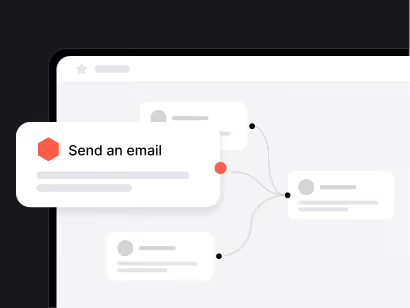
A single journey can change channel
Send the email, wait a day, see who clicked, then text only the people who did not and who opted in to SMS. Spend goes down and reach goes up, which is a combination you do not get often. Across two separate tools the pattern collapses, because the contact bases cannot be reconciled fast enough to trust.

Behavior from any channel feeds segmentation
A click in a text, a page view on your site and a chat conversation all land on the same profile. That is the difference between a segment built on real customer interactions and one you can describe in a meeting.
Reporting follows the customer journey
One result read across channels, instead of four dashboards each claiming the same conversion. Data analytics that measure a journey rather than a channel are the only kind that answer whether the journey worked, and they are what tell you which customer needs you are actually meeting.
Journeys built in a visual editor
Journeys are built visually, so adding a channel to a live journey is a step in the editor. How much setup sits around it, data sources and integrations included, depends on your stack.
What this looks like with real customers
These three come from our published customer stories. Their figures measure specific programs rather than full omnichannel setups, and it is worth saying that out loud rather than letting the numbers imply something broader.
LG Electronics reports a 50% open rate and doubled revenue. Read the LG Electronics story.
Carrefour reports an 88% revenue increase. Read the Carrefour story.
Somfy grew its subscriber base by 162%. Read the Somfy story.
Customer loyalty follows from messages that respond to what someone actually did. Nobody stays loyal to a brand that talks past them.
How to judge an omnichannel platform
Feature lists will not separate the candidates, because every vendor ticks every box and every demo looks good, which is what demos are for. These six questions will.
Put the answers side by side. A table built from your own answers beats a comparison published by any of the candidates, ours included.
Why Positive User
Seven channels on one record
Email, SMS, WhatsApp, web push, mobile push, mobile wallet and live chat, reading the same profile and the same segments. Most stacks reach that coverage by wiring three products together, and that is exactly where the synchronization problems start.
One set of consents
Consent and opt-out are recorded once and apply everywhere, so an opt-out given in one channel is respected in all the others.
Data stored securely in Europe
Customer data is stored in Europe, in France and Germany. For US companies with European customers, and for anyone who has to document where personal data physically sits, that question gets a one-sentence answer.
Test it on a real journey
During a demo, ask the person who will use the platform every day to build a journey in the visual editor. It is the fastest way to see whether the tool fits the team you actually have.
Channel coverage, available connections and the full journey library are on the Positive User omnichannel platform page.
Want to watch a journey run across channels on your own data? Book a Positive User demo.
Frequently asked questions
One question to ask before anything else
Before you add another channel, check whether an opt-out recorded in one existing channel shows up in all the others.
If it does not, adding channels will make the customer experience worse, and the work in front of you is the customer record. If it does, the structure for an omnichannel strategy is already there, and the next channel will genuinely extend your reach.
Start free or book a demo, and see email, SMS, WhatsApp and wallet running from one journey, with your data stored in Europe.