




Summary
Your customers no longer type “running shoes” into a search bar. They write: “I’m running a marathon in three months, I have flat feet and weigh 85 kg, which model has the best cushioning for under €150?” And they’re asking ChatGPT, Gemini or Perplexity.
This shift is rewriting the rules of e-commerce. According to McKinsey’s ConsumerWise study, 50% of consumers already use generative AI to research a product. Yet Gartner finds that only 11% are willing to hand it the buying decision.
The takeaway fits in a single sentence: AI makes you visible, but the purchase still happens on your site. That creates a twofold challenge you’ll need to meet:
- Being visible and cited by LLMs and AI Overviews.
- Converting a visitor who arrives with an ultra-specific intent, with zero friction in the experience, whatever the channel.
That’s exactly what our playbook “AI & E-commerce: From Prompt to Purchase” breaks down: the concrete levers to pull, step by step. No form, no data required.
Getting cited by AI isn’t down to luck
To be visible in AI, you need to master two complementary pillars:
First, SEO remains the foundation: pages ranking first organically have roughly a 25% chance of being cited as a source in AI Overviews. No AI visibility without a healthy SEO base.
Next, GEO (also called AEO or AI SEO) optimizes your content for generative engines: targeting intent in the form of prompts, structuring your data (Schema.org: price, stock, reviews) and extending your authority off-site.
That leaves the real sticking point: knowing where you stand today in AI answers, and which prompts you’re missing from. That’s exactly what Positive Surfer measures and automates. e explain how in the playbook.
The click isn’t enough: converting without friction
A visitor used to AI-driven personalization won’t tolerate a generic experience. Three habits make the difference:
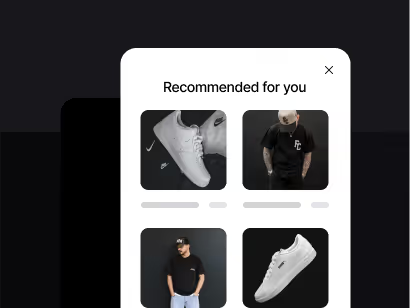
- Contextual onboarding : your site detects the AI source and tailors the welcome.
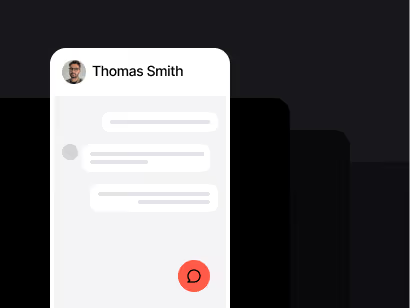
- Proactive micro-interaction : a help bubble at the exact moment of hesitation.
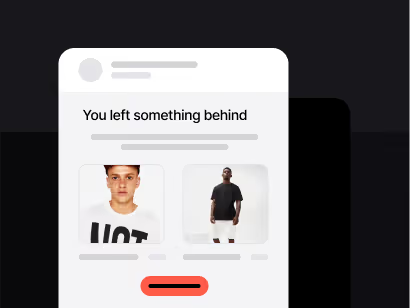
- Omnichannel follow-up : web push, email, WhatsApp, SMS, precisely timed — to bring back those who leave without buying.
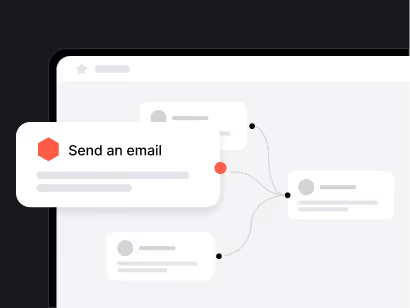
At scale, orchestrating these signals isn’t something you do by hand : that’s the job of an engagement platform like Positive User. Found, welcomed, reassured, re-engaged: the playbook walks through each of these four critical moments, one by one.
The journey in action: from AI search to purchase
Take Thomas, 34, looking for an ultra-light trekking tent.
- The search. He asks ChatGPT for the best tent for his needs. Thanks to semantic optimization (GEO), the AI picks out the product and includes a direct link to the store.
- The landing. On the product page, the site detects the AI source and highlights the technical specs he was after. No generic pop-up.
- The hesitation. Thomas adds the tent to his cart, then hesitates for 45 seconds. A proactive help bubble clears the doubt.
- The distraction. His phone rings and he closes the laptop. A web push at +15 min, then a WhatsApp at +2 h (“Your cart is saved: only 2 left in stock”), bring Thomas back, and he completes the payment from his phone.
Found, welcomed, reassured, re-engaged: conversion is won at every link in the chain, from the first prompt to the payment.
You’ve just seen the four critical moments in fast-forward. The playbook “AI & E-commerce: From Prompt to Purchase” details each one, with the concrete levers to pull at every stage.
No form, no data required. Read it freely.