



Summary
Your future travellers no longer type “French Alps ski resort” into a search bar. They write: “We’re a family of four with children aged 6 and 9, looking for a resort in the French Alps in February, ski-in/ski-out, with a kids’ club, for under €2,500 a week” and they put the question to ChatGPT, Gemini or Perplexity.
It’s the fastest shift in traveller behaviour the industry has seen in a decade: according to Phocuswright, 56% of American travellers used AI for at least one trip over the past twelve months, up from 43% nine months earlier. Yet Gartner finds that only 11% of consumers are willing to hand it a purchase decision.
The takeaway fits in a single sentence: AI makes you visible, but the booking still happens on your own site. Hence a twofold challenge: getting cited by LLMs on hyper-contextual prompts, then converting the traveller’s intent across a decision cycle that often stretches over several weeks.
And there’s a stake specific to the sector: after a decade spent fighting OTAs for direct bookings, AI adds a second layer of intermediation. Every direct booking won back means margin and customer data recovered.
This is exactly what our playbook “AI & Travel: from prompt to booking” breaks down, step by step. No form, no data required.
The real risk isn’t a drop in traffic : it’s double disintermediation
Avoiding disintermediation by AI on top of the disintermediation OTAs already drive means being visible. And that comes down to mastering two complementary pillars:
First, SEO remains the foundation: pages ranking first organically have roughly a 25% chance of being cited as a source in AI Overviews. There’s no AI visibility without a healthy SEO base.
Then GEO (also called AEO or AI SEO) optimises your content for generative engines: targeting intent in the form of prompts, structuring your data (Schema.org: LodgingBusiness, TouristDestination, Event, Offer, FAQPage) and extending your authority off-site.
That leaves the real challenge: knowing where you stand today in AI answers, and on which prompts you’re absent. This is what Positive Surfer measures and automates and we detail how in the playbook, available here:
After the click, holding intent through to the booking
A stay is rarely booked in one session: people compare, talk it over with family, then come back. Three reflexes make the difference:
• contextual onboarding: the site detects the AI source and tailors its welcome;
• proactive micro-interaction: a reassurance prompt at the exact moment of hesitation (cancellation, snow guarantee, what the package includes);
• omnichannel follow-up (web push, email, WhatsApp, SMS), timed to the long rhythm of travel.
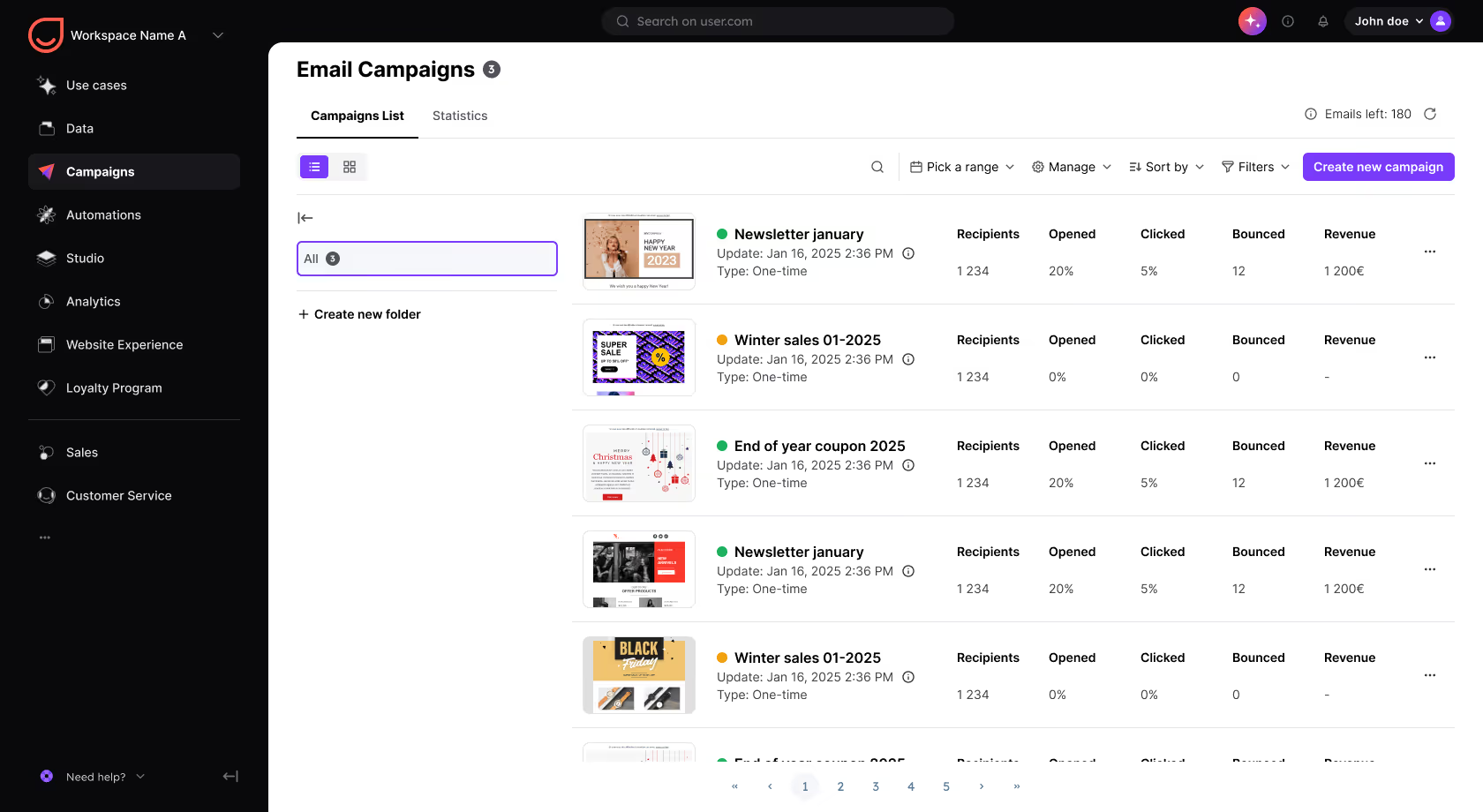
At the scale of a destination, orchestrating these signals can’t be done by hand: that’s the role of an engagement platform like Positive User, which unifies behavioural data in real time, including that of anonymous visitors.
Example: converting a week of skiing, from the first prompt to confirmation
Léa, 38 ans, organise un séjour au ski en famille.
- The search. She asks ChatGPT; thanks to semantic optimisation, the AI identifies the destination and points to the site, not to an OTA listing.
- The landing. The page highlights exactly what she was after: a kids’ club open in February, ski school for ages 6 and 9, family apartments.
- The hesitation. Forty-five seconds stuck on the cancellation terms. A help prompt clears the blocker: free cancellation up to 14 days out, snow guarantee included.
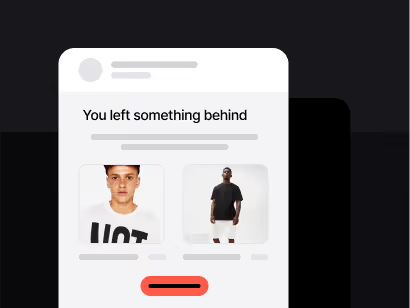
- The distraction. She closes her laptop to talk it over with her partner. Web push at +15 min, email on day 2 with the detailed itinerary, WhatsApp on day 7 (“only 2 apartments left for your dates”): Léa confirms from her phone.
Found, welcomed, reassured, re-engaged: conversion is won at every link in the chain.
And in travel, the chain continues after the booking: pre-stay, on-site add-on sales, re-engagement on return.
And to see where you stand: the "From Prompt to Booking" scorecard evaluates your AI visibility and your ability to convert this traffic into bookings in just a few minutes, then provides you with a prioritized action plan.