


Summary
SMS marketing is texting customers who gave permission to receive commercial messages. It splits into promotional texts, which need explicit consent in the EU, and transactional ones such as a shipping notice, which generally do not. The channel is billed per message sent rather than per contact stored, which is the single fact that shapes how it has to be run: weak segmentation shows up on an invoice rather than in an open rate.
Your SMS list is the smallest audience you own, the most expensive one to reach, and the only one that reads everything you send.
That combination is strange enough that most teams get it wrong in the same way. They treat it like email, send SMS messages to everybody, and watch a fifth of the list walk out before lunch. Opting out of a text takes one word and you see it happen while it happens, which is nothing like the slow quiet drift of email unsubscribes.
Used properly, SMS marketing is the only channel that can reliably put something in front of somebody in the next five minutes. This guide covers what that costs, what European law actually requires, which SMS marketing messages to switch on first, and who is really sending your texts, which is probably not who you think.
What SMS marketing covers
SMS marketing is texting customers who agreed to hear from you. Two kinds of message live under that name, and the rules for them are not remotely the same.
Promotional SMS messages sell something. An offer, a launch, an event. In the EU you need explicit consent before sending promotional text messages, and every message carries a free way out.
Transactional SMS messages tell people something they are already waiting for. Order confirmed. Parcel shipped. Delivery before 6pm. Login code. These fire off an action the customer took, and in most of Europe they need no marketing consent at all. Our guide to setting up transactional SMS covers the mechanics.
The line between the two is easier to cross than it looks, and crossing it is usually an accident. Drop a discount code into an order confirmation and a regulator treats the entire message as marketing, including the consent requirement you did not meet. It is a tempting shortcut. It is not worth taking. You can see how both run inside one journey on the Positive User SMS marketing platform.
The economics nobody mentions until the first invoice
SMS is billed per message sent, not per contact stored. One difference, and it quietly changes everything about how the channel has to be run.
With email, weak segmentation costs you a slightly worse open rate. With SMS messaging it arrives as an invoice. A send to 50,000 people has a price attached before anybody has clicked anything, and you will find out the exact number at the end of the month.
Length is part of that price, which is the detail that catches people out. A standard text holds 160 characters in the GSM-7 alphabet. Add an emoji, a curly apostrophe or an accented character and the message flips to Unicode encoding, which drops you to 70. Anything longer splits into 153-character segments and every segment is billed. A single emoji can double the cost of a campaign, and nobody notices until the invoice.
Two things follow from this and they shape the rest of the guide. Automated messages beat SMS campaigns, because they go to small numbers of people at moments those people are ready to act. And your list is a retention asset rather than an acquisition one, because everybody on it already knows you and every touch costs money.
None of this makes SMS expensive. It makes it unforgiving of laziness, which is a different problem and frankly a more useful one to have.
Who actually sends your messages
Marketing platforms handle SMS one of two ways, and the difference lands on your invoice and in your compliance file.
Some SMS marketing software resell messaging. You buy credits at their rate and they handle delivery through carriers you never see or think about. Simple to start with, and you pay a margin on every message you ever send.
Others orchestrate, and you bring your own gateway. Positive User works this way. You hold the contract with an SMS provider and connect it, and the platform then handles content, targeting, journeys and reporting while the gateway does the actual delivering.
The honest version of the trade-off, since you should hear it from us rather than from a competitor: this is one more account to open before your first send, and because we do not run the delivery infrastructure, your delivery rate is your provider's responsibility rather than ours.
What you get back matters more in Europe than almost anywhere else. You negotiate your own per-message rate instead of paying a reseller's margin on top. You can pick a provider that already operates in your markets, which is the difference between being able to register a sender ID in Poland or Italy and discovering three weeks before launch that you cannot. And if the rates or the coverage stop working for you, you change provider without changing marketing platform.
What European law asks of you
Most SMS advice written in English is written for the United States, where the rules are built differently. If you send into Europe, four things hold everywhere.
- Explicit consent before any promotional SMS messages. Freely given, specific, informed. A pre-ticked box is not consent and has not been for years.
- A free opt-out in every marketing communications message, acted on immediately.
- A sender the recipient can identify from the message itself.
- A lawful basis and a documented retention period for the phone numbers you are holding.
Then every country adds its own layer on top. France restricts promotional SMS messages to defined daytime hours on weekdays and Saturdays and bans them on Sundays and public holidays. Germany, Italy, Spain and Poland each enforce their own way, and sender ID registration works differently in each.
If you send across markets, the SMS marketing software has to apply those rules itself. Leaving it to whoever happens to be scheduling that week does not survive a busy December, and it quietly makes a junior marketer your compliance control, which is not a position anybody applied for.
One more thing, and it is the first question your legal team will ask: where the phone numbers are stored. Run European phone numbers through a US-hosted platform and somebody eventually has to justify the transfer in writing.
Which SMS marketing messages to switch on, and in what order
Order matters more than copy here, because your first few text messages decide whether anybody sticks around for the rest.
SMS messages people are waiting for
Order confirmation, shipping notice, delivery window, appointment reminder, login code. The highest volume use of SMS marketing in Europe by a wide margin, the lowest opt-out risk, and in most jurisdictions no marketing consent required.
SMS marketing messages that are only useful right now
Back in stock on the thing somebody asked about. A webinar reminder two hours before. A sale closing tonight. Urgency is the one thing SMS marketing does better than every other marketing channel, so spend it on things that are actually urgent.
SMS marketing messages with an obvious rhythm
A welcome text after signup. A renewal reminder before a subscription lapses. A reorder nudge timed to how long the product really lasts. A birthday. These read as service rather than sales, because the timing makes sense to the person receiving them.
SMS campaigns for reactivation
Somebody who has not been back in a couple of weeks, or a win-back at 90 days.
Abandoned cart, last, and carefully
It works, and it is the single most promoted SMS use case online, mostly because the US direct-to-consumer playbook was written by platforms selling into that market. It is also the most intrusive message on this list. It fires within the hour, it makes plain that you were watching somebody browse, and in the EU it needs explicit marketing consent that plenty of SMS subscribers gave you for delivery updates and nothing else. Run it after everything above and expect a higher opt-out rate than anything else you send.
Writing to the constraint
Brand name first, so people know who you are from the notification preview. One offer. One shortened, trackable link. The opt-out at the end. Stay inside one segment unless the second genuinely earns its cost.
Most first drafts are twice as long as they need to be, and here the length has a price tag. Same SMS marketing message, before and after a real edit:
> Before. 191 characters, two billed segments.
Hello Sarah, we wanted to let you know that the item you asked us about at Maison B is now back in stock and available to order again on our website. Click here to view it before it sells out.
> After. 112 characters, one segment.
MAISON B: Sarah, the boots you wanted are back in stock. 3 pairs left: [link] STOP to opt out
Half the cost, and it reads better. Do that edit on every SMS campaign. And send yourself a test before publishing, because a broken link in a text message cannot be fixed after the fact and you paid for every one of them.
SMS marketing with Positive User
SMS marketing runs on the same contact record as email, WhatsApp, web push, mobile push, mobile wallet and live chat, with one set of consents across all of them.
One journey can change channel
Send the email, wait a day, check who opened it, then text only the people who did not. Your SMS spend falls and your campaign reach rises at the same time, which is not a combination you get offered often. Across two separate tools the pattern is unusable, because you cannot reconcile the contact bases fast enough to trust what you are looking at.
Click tracking depends on the built-in link shortener
Worth knowing before somebody switches it off to save characters. Turn it off and the message still sends, still gets read, and records no click data whatsoever. It is the only engagement signal SMS marketing gives you, and a campaign without it is a campaign you cannot judge.
Delivery logs price each message individually
Every message appears with its status, its failure reason if it failed, and the price calculated for sending it. Put that next to the clicks tab and you have cost and response at the level of the individual message, which is the only honest way to judge an SMS program.
Numbers have to be in E.164 format
Country code, no spaces, as in +33600000000. Anything else fails at send. This stops more first SMS campaigns than any other single thing, and it always gets discovered on launch day.
What this looks like with real customers
An honest note before the numbers. We do not currently publish SMS-specific results. What follows measures email and automation, and it is here because the mechanism is the one this article argues for, not because these are SMS benchmarks wearing a disguise.
LG Electronics reports 50% open rates on automated campaigns and doubled revenue after moving to behavior-triggered messaging. Read the LG Electronics story.
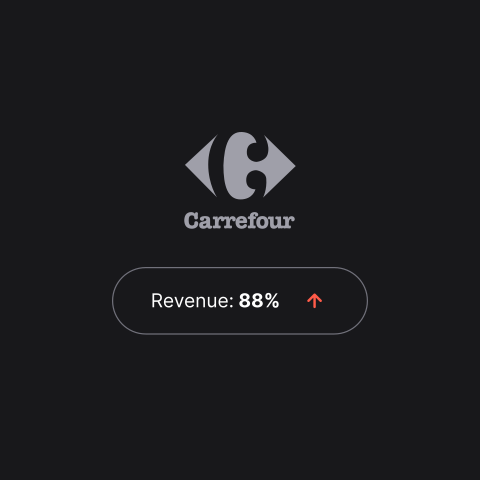
Carrefour puts an 88% revenue increase down to automation. Read the Carrefour story.
Both got there through triggered, segmented messaging rather than volume. That is exactly how an SMS marketing strategy should be built, and it is the part that transfers.
How to judge an SMS marketing platform
Feature lists will not separate the candidates, because every vendor has every feature and every demo goes well. These six questions do separate them.
Put the answers side by side. A table built from your own answers beats a comparison published by any of the candidates, ours included.
Why Positive User
Your own gateway, your own rates
You keep the contract and the price you negotiated instead of paying a platform margin, and you can choose a provider that already works where your customers are.
One record, one consent state
SMS, email, WhatsApp, web push, mobile push, wallet and chat all read the same profile. An opt-out is recorded once and applies everywhere.
Cost and response at message level
Delivery logs show the price of each individual message alongside whether it arrived and who clicked it.
Data stored in the European Union
A storage location rather than a clause about transfers.
No engineering queue
Journeys are built visually. The demo test worth insisting on: hand the keyboard to whoever will run this daily and ask them to build a two-channel journey while you watch.
Channel coverage and available gateways are on the Positive User SMS marketing page.
Want to see a text message fire off real behavior? Book a Positive User demo.
Frequently asked questions
What is SMS marketing?
SMS marketing is texting customers who gave permission to receive commercial messages. It covers SMS campaigns, such as a seasonal offer to your opted-in list, and automated messages triggered by behavior, such as a reorder reminder. It is separate from transactional SMS, which delivers information the customer is already expecting and carries no promotional content.
Do I need consent to send marketing texts in Europe?
Yes. Promotional texts to individuals need explicit opt-in that is freely given, specific and informed. Consent for email does not cover SMS, so you collect it separately. Every marketing message needs a free opt-out, and you need to be able to prove when and how somebody agreed, which means storing it rather than assuming it.
Can I text numbers I collected for delivery?
No, and this is the most common expensive mistake in the channel. A phone number given so a courier could call was collected for a different purpose and is not a marketing list. Sending promotional SMS messages to it needs separate, knowing consent that you gathered and documented at the time.
How long can a marketing text be?
160 characters in GSM-7, or 70 if there is an emoji or an accented character in there. Longer text messages go out as 153-character segments, each billed separately. In practice you have about 130 characters for the message, with the rest going to a shortened link and the opt-out.
What does SMS marketing cost?
You pay per message sent, at a rate that varies by destination country and carrier. Budget on volume and segment count rather than on list size, and remember that length has a direct effect, because a two-segment text message costs exactly twice a one-segment message for the same idea.
When should I send?
Late morning and early evening generally do best in retail, but regulation narrows the window before preference gets a say. Several European countries prohibit promotional SMS messages at night, on Sundays and on public holidays, so send times are set per country and not globally.
How do I know if SMS is profitable?
Compare cost against response at the message level rather than looking at aggregate rates. Open rates on SMS are close to universal, so they do not distinguish a good send from a bad one. Because every text message has a unit cost, only cost against response tells you whether a send paid for itself.
Can SMS be automated alongside email?
Yes, when both run on the same SMS marketing platform. One journey can send an email, wait, check engagement, then text only the people who did not open it. Split across two tools it does not really work, because you cannot reconcile the contact bases fast enough to trust what you are looking at.
Before your first send
Two things to check, and neither of them is the copy.
Do the phone numbers in your database have documented marketing consent, separate from email consent? And is the first SMS message you plan to send one the recipient is actually expecting?
If both answers are yes, the channel starts earning in the first week. If either is no, that is the work, and it comes before anything you write.
Start free or book a demo, and see SMS marketing running alongside email, WhatsApp and wallet from a single journey, with your data stored in Europe.