







Summary
Lead scoring is a method of assigning points to leads based on how well they fit your ideal customer and how much interest they show, so sales can prioritize the most promising ones. Models combine explicit data, such as job title or company size, with implicit data, such as pricing page visits or demo requests. A score works when sales helped define it and when it is reviewed every quarter.
{{BUTTON-1}}
Marketing sends sales 200 leads this month. Sales calls the first twenty, finds students, competitors and people who downloaded one ebook in 2023, and stops calling. Next month, the lead that was ready to buy waits three days for a reply. Lead scoring fixes that by ranking leads on fit and intent, so the right ones reach a rep first. It's one of the automations described in our marketing automation guide.
What is lead scoring?
Lead scoring is a method of assigning points to leads based on how well they fit your ideal customer and how much interest they show, so sales and marketing teams can prioritize leads based on their likelihood to buy and focus on the most promising leads. A lead's score rises with signals like a matching job title or repeated visits to the pricing page, and falls with signals like inactivity.
A lead score tells your team where to look first. The conversation with the lead still decides.
Why is lead scoring important?
Without scoring, every lead looks the same in the CRM, whatever your lead generation efforts produce. Sales reps waste time on contacts who will never buy, and qualified leads cool down while they wait. With a shared lead scoring system, marketing and sales teams agree on what a sales qualified lead is. The sales team spends time on high quality leads and high value leads instead of low quality leads, which raises sales productivity and speeds up sales follow up, while marketing teams nurture leads that aren't ready yet. Lead scoring helps both sides align marketing efforts and sales efforts on the same buying cycle.
Explicit and implicit lead scoring criteria
Most lead scoring models combine two kinds of data.
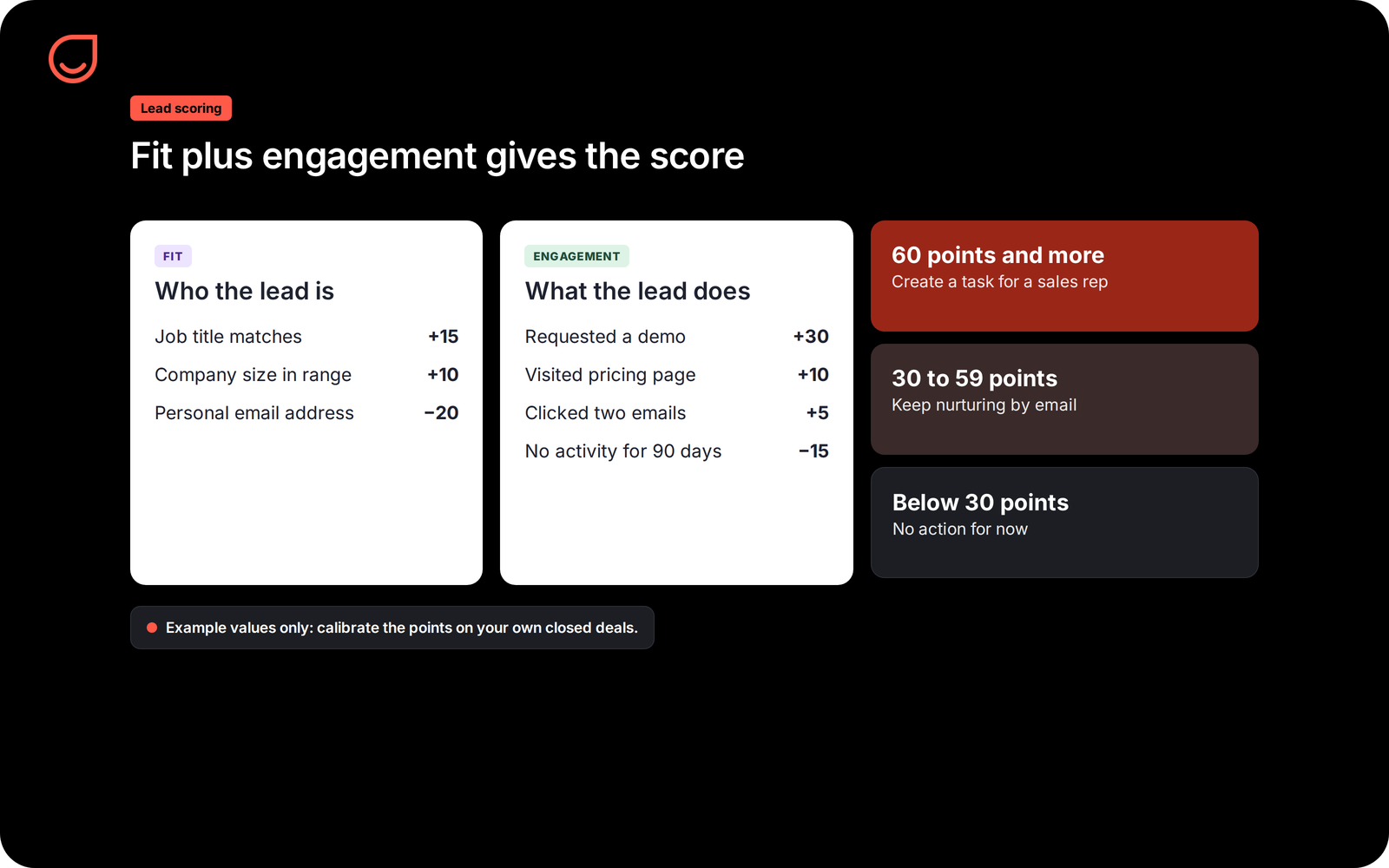
Explicit data (fit) is what you know about the lead: job title, company size, industry, country, budget. It answers "is this the kind of customer we want?"
Implicit data (engagement) is behavioral data about what the lead does: website visits, emails clicked, lead forms submitted, demo requests, webinar attendance, product usage. It answers "is this lead interested now?" This behavioral scoring builds an engagement score that changes as lead behavior changes. Some teams add intent data from third-party sources.
How to build a lead scoring model in 6 steps: the scoring process
- Look at your closed deals. Compare existing customers with leads who didn't buy and identify patterns: which data points and actions show up in the first group? Good quality data matters more than many data points.
- Agree on definitions with sales. Define the marketing qualified lead (MQL) and the sales qualified lead (SQL) together, in writing.
- Choose your criteria and assign point values. Give the most points to the signals that best predict a purchase, such as a demo request, and fewer to light signals like a single email click.
- Add negative scoring and score decay. Remove points for bad fit and let engagement points expire, so a lead who was active six months ago doesn't stay "hot".
- Set thresholds and actions. Define a minimum score for sales follow-up. For example: above 60 points, a hot lead gets a task for a sales rep; between 30 and 60, keep nurturing; below 30, no action. Higher scores should mean a higher priority lead, every time.
- Review every quarter and fine tune. Check how many leads generated with high scores became opportunities and adjust the weights.
Manual, automated and predictive lead scoring
Manual lead scoring means a team assigns points in a spreadsheet or the CRM by hand; it's fine to test a model, but it doesn't scale. Automated lead scoring updates the score as soon as a signal arrives, inside your marketing platform or lead scoring software. Predictive lead scoring uses machine learning on your historical data to estimate which leads are most likely to convert, instead of points you assign by hand. It can surface patterns people miss, but it needs enough closed deals to learn from and a model your team can understand. Many teams start with a rule-based model and move to a predictive lead scoring model once they have the data volume. Whatever the lead scoring tool, the goal is an objective quality rating that helps you rank potential customers and target leads with the right marketing campaigns.
Lead management and lead scoring with Positive User
In Positive User, the signals behind a score live on one contact record: website visits, email and SMS engagement, form submissions and CRM data. In the Journey Builder, those signals can trigger workflows: a quote request or a return to the pricing page can update the contact, create a deal and alert the owner, while leads that aren't ready yet enter a nurturing sequence. Sales and marketing work from the same data, which is what makes a score credible. More on the Positive User sales features.
{{CTA-BLOG}
Common lead scoring mistakes
- Scoring without sales. If sales didn't help define the model, they won't trust the leads it sends.
- Too many criteria. Forty weighted signals are hard to explain and harder to maintain. Start with eight to ten.
- No decay. Old engagement keeps leads artificially high.
- Counting email opens. Opens are inflated by mail apps that load images automatically; use clicks and site visits instead.
- Set and forget. Markets, offers and buyers change. A model that isn't reviewed drifts away from reality.
FAQ
Start with your last 20 deals
List the attributes and actions shared by your last 20 customers, turn the five strongest into scoring criteria, and agree on one threshold with sales. Run it for a quarter before you add complexity.
Turn lead signals into sales follow-up